
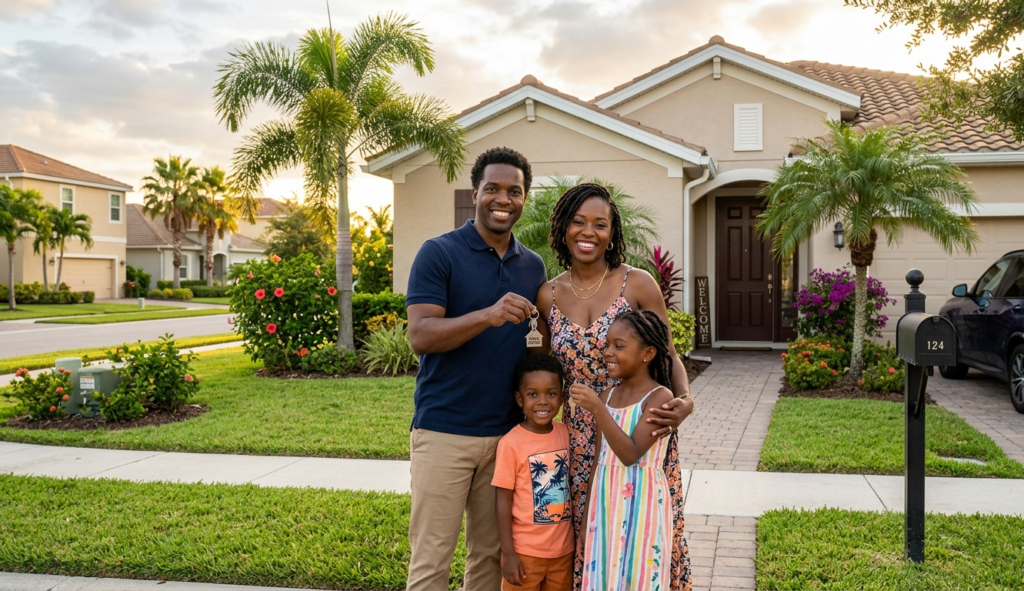
Building Black Homeownership in Florida — The Gap Is Real. So Is the Path Forward.
Black homeownership in Florida lags nearly 30 percentage points behind white homeownership. But data, down payment programs, and a growing network of Black real estate professionals are changing what’s possible right now.
Homeownership has been the primary vehicle for middle-class wealth building in America for generations. The family home — appreciating over time, paying off a mortgage instead of a landlord, passing equity to children — is how most American families accumulate wealth between generations.
Black families have been systematically excluded from that vehicle. Redlining. Discriminatory lending. Appraisal bias. Predatory loans during the 2008 crisis that wiped out gains it took decades to build. These aren’t historical footnotes — their effects show up in today’s numbers.
The gap is real. And it’s closeable — but it takes specific knowledge, the right professionals, and access to programs that most people don’t know exist. That’s what this guide is for.
The Numbers Don’t Lie — But They Don’t Have to Be Permanent
The increase in Black homeownership is the most meaningful data point here. It didn’t happen by accident. It happened because more Black buyers entered the market with better information, better advocates, and better access to programs designed for them. This guide is part of that work.
The Real Barriers — Named Plainly
Most conversations about the Black homeownership gap stop at “credit” and “income.” The full picture is more complicated — and more actionable when you understand it completely.
Find a Black Realtor or Mortgage Broker Near You in Florida
BlackOwnedFlorida.com connects you with verified Black real estate professionals across every region of the state — agents, brokers, and lenders who specialize in first-time buyers, FHA, ITIN, and down payment assistance.
Browse Black Professionals →Florida Down Payment Programs That Are Moving the Needle
Florida has one of the most robust down payment assistance landscapes in the country. Most eligible buyers never hear about these programs — or hear about them too late. Here’s what exists right now.
🏅 Florida Hometown Heroes Housing Program
For first-time homebuyers employed full-time in Florida. Covers essential workers including teachers, nurses, law enforcement, healthcare workers, childcare staff, and active military/veterans. Structured as a 0% interest deferred second mortgage — no monthly payments, repaid when you sell or refinance. The program income limits range from approximately $143,000–$195,000 depending on county. Requires 640 credit score for government-backed loans, 680 for conventional.
🏠 Florida Assist (FL Assist)
Broader eligibility than Hometown Heroes — you don’t need to be an essential worker. Available to first-time homebuyers statewide through Florida Housing Finance Corporation. Works alongside FHA, conventional, USDA, and VA loans. Income limits apply by county.
🏘️ SHIP Funds (State Housing Initiatives Partnership)
Florida’s SHIP program distributes federal funds to each county, which then administers local down payment and repair assistance. Amounts vary dramatically by county — some counties have had more than $60,000 available for qualifying first-time buyers. Contact your county’s housing office or a mortgage broker familiar with local SHIP availability.
🎖️ VA Loan (0% Down)
If you’re a veteran, active duty service member, or qualifying surviving spouse, the VA loan is the most powerful homebuying tool available to you — and only about 15% of eligible veterans use it. No down payment, no private mortgage insurance, competitive rates, and the most flexible DTI thresholds of any loan program.
Key insight: Many Florida buyers stack multiple programs — for example, a Hometown Heroes second mortgage combined with a local SHIP county grant — potentially totaling $50,000+ in combined assistance. A mortgage broker who knows Florida’s assistance landscape is essential to maximizing what’s available.
Your 12-Month Florida Homeownership Roadmap
Here is the exact sequence of actions that moves a first-generation buyer from “I want to own someday” to keys in hand — with realistic timelines for each step.
Pull Your Credit & Know Your Numbers
AnnualCreditReport.com — all three bureaus. Know every account, every balance, every open collection. Calculate your estimated DTI. This is the foundation everything else is built on.
Repair & Optimize Your Credit Profile
Pay utilization below 30% on every card. Dispute errors. Don’t open new accounts. Build a paper trail of every action. If your score is below 580, this stage may take 3–6 months.
Get Pre-Approved with a Mortgage Broker
Not a bank — a broker. Brokers access dozens of lenders and programs at once, including overlays you’d never find walking into one institution. Ask specifically about FL Hometown Heroes, SHIP funds, and any local county DPA programs available where you’re buying.
Complete a Homebuyer Education Course
Most Florida DPA programs require a HUD-approved course (6–8 hours, available online for free or low cost). This step unlocks down payment assistance and gives you the education to protect your investment after you close.
Work with a Black Realtor to Find Your Home
Pre-approval in hand, you’re a real buyer. Engage a local Black realtor who knows the neighborhoods, the HOA considerations, the school district values, and the Florida-specific issues (insurance, flood zones) that affect which home is actually a good investment.
Contract, Inspection, Underwriting, and Close
This is where your team matters most. A great agent protects you in negotiation and inspection. A great mortgage broker keeps your file moving through underwriting. Budget 30–60 days from contract to close for most Florida transactions.
Frequently Asked Questions
What is the Black homeownership rate in Florida?
Florida’s Black homeownership rate mirrors the national picture — approximately 44.7% according to NAR’s 2025 data, compared to 72.4% for white households. The gap has persisted for decades due to structural exclusions from wealth-building systems, but Black homeownership achieved the highest year-over-year gain of any racial group in the most recent reporting period.
What Florida programs specifically help Black homebuyers?
While most Florida housing programs are not race-specific, several were designed to close structural access gaps: Florida Hometown Heroes (up to $35,000 for essential workers), Florida Assist ($7,500, deferred), SHIP county funds ($10,000–$60,000+ depending on county), and VA loans for veterans (0% down, no PMI). Stacking multiple programs is possible and maximizes available assistance.
How does homeownership build generational wealth for Black families?
When you own a home, your monthly payment builds equity — ownership stake — rather than paying a landlord’s mortgage. Over time, appreciation grows that equity further. That equity can be passed to children, used to fund education or business investment, or tapped through refinancing. For families who have historically been locked out of this system, the first homeownership transaction in a generation is the start of compounding wealth that extends beyond the buyer.
What is appraisal bias and how can I protect myself?
Appraisal bias occurs when a home in a predominantly Black neighborhood is valued lower than comparable homes in white neighborhoods — even with similar size, condition, and amenities. To protect yourself: request a reconsideration of value if your appraisal seems low, provide your own comparable sales data, consider the “appraisal gap” when negotiating, and document the basis for any challenge. Some buyers have also had success requesting a different appraiser when bias is evident.
Do I need a real estate agent to use down payment assistance in Florida?
No — you don’t technically need an agent to access most DPA programs. However, an experienced agent familiar with Florida’s assistance programs can help ensure your contract terms are compatible with DPA timelines and requirements. Some programs have specific conditions around contract length and seller concessions that require coordination between your agent and your lender.
Start Your Florida Homeownership Journey Today
Connect with a verified Black realtor and mortgage broker in Florida who can walk you through every program, every option, and every step — from first conversation to closing day.
Find Your Black Real Estate Team →Build generational wealth — find a Black realtor or mortgage broker in Florida.
Find Your Agent →