
The Inspection That Decides If Your Home Can Even Be Insured
If your home is over 20 years old, an insurer is going to look hard at your roof, wiring, plumbing, and HVAC before they’ll cover it — and homes in Florida’s historic Black neighborhoods, often built decades before newer subdivisions, are disproportionately on the hook.
A 4-point inspection sounds like paperwork until it’s the reason your insurance quote triples, or the reason a carrier declines to cover the home at all. It’s a targeted inspection of a home’s four highest-risk systems, and Florida insurers lean on it heavily for homes generally over 20 years old. That threshold quietly puts more weight on communities where the housing stock is older by design — including many of Florida’s historic Black neighborhoods, built in the era before redlining-era disinvestment slowed new construction and infrastructure updates in those areas for decades. Understanding this inspection before you’re staring at a denial letter is the difference between a manageable repair and a deal falling apart at the worst possible moment.
What Is a 4-Point Inspection, Exactly?
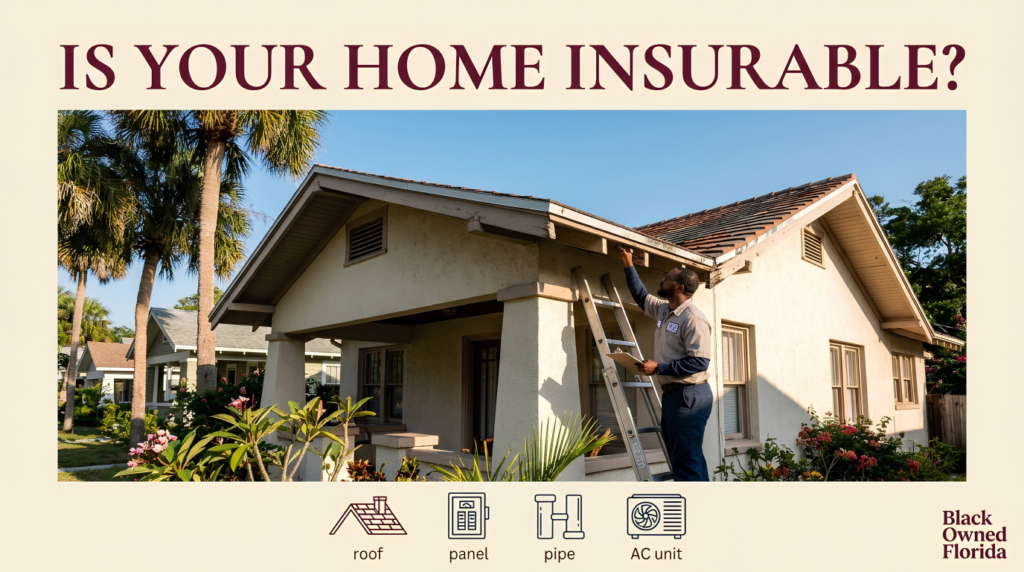
Unlike a full home inspection (which a buyer typically orders to evaluate the whole property before purchase), a 4-point inspection exists purely for the insurance company’s risk assessment. It checks: the roof’s age, material, and condition; the electrical panel brand, breaker condition, and wiring type; the plumbing’s supply and drain lines and water heater condition; and the HVAC system’s age and functioning. Each item gets a pass, or a flag that can trigger a higher premium, an exclusion, or an outright decline until it’s fixed.
Why This Hits Historic Neighborhoods Harder
This isn’t a story about neighborhood value or maintenance — it’s about construction era. A home built in the 1960s or 70s that has never had its systems upgraded is statistically far more likely to fail one or more of the four inspection points than a home built in a 2015 subdivision, purely because of what materials and codes existed at the time it was built. Families who inherited homes in these neighborhoods, or who are buying into them now at more attainable price points, are the ones most likely to run into this wall — and the ones who benefit most from knowing about it before it becomes an emergency.
The Four Things That Actually Fail an Inspection
Roofing failures are the most common and most expensive to fix — a full replacement can run $12,000 to $20,000+ depending on size and material, though partial repairs are sometimes enough to pass. Electrical failures often center on outdated panel brands (some of which insurers refuse to cover regardless of condition) or aluminum branch wiring, both fixable through a licensed electrician for a few thousand dollars. Plumbing issues usually involve old cast iron or polybutylene pipe, which can sometimes be addressed with partial repiping rather than a full replacement. HVAC failures are the cheapest fix relative to the others — often resolved with a straightforward unit replacement.
What to Do Before the Inspection Becomes a Problem
The families who navigate this well are the ones who treat the inspection as a planning tool, not a surprise. If you’re selling an inherited family home, get a 4-point inspection done before you list it — you can then decide whether to make repairs first or price the home accordingly and disclose the condition upfront. If you’re buying an older home, make your offer contingent on both financing and a passing (or fixable) 4-point inspection result, and get an insurance quote on the specific property before you’re locked into a closing date.
🏠 4-Point Inspection Readiness Checklist
If your home is over 15–20 years old, check what you already know about each system.
Get ahead of it before an insurer forces the timeline.
Talk to a Black-owned Florida insurance agency about what your specific home’s age and condition means for coverage.
Find a Black-Owned Insurance Agency →Frequently Asked Questions
At what age does a home need a 4-point inspection in Florida?
Most Florida insurers require a 4-point inspection for homes older than roughly 20 years, though the exact threshold varies by carrier — some require it as early as 15 years, especially for older roofing or electrical systems.
What does a 4-point inspection check?
It evaluates four systems: the roof (age, material, condition), the electrical system (panel type, wiring, breakers), the plumbing (supply and drain lines, water heater), and the HVAC system (age and functionality).
Can I still get homeowners insurance if my home fails a 4-point inspection?
Often yes, but it may require repairs first, come with a higher premium, or include exclusions for the failed system. Many issues, like an outdated electrical panel or an aging roof, can be repaired and reinspected for approval.
How much does it cost to fix a failed 4-point inspection item?
Costs vary widely: electrical panel updates often run a few thousand dollars, plumbing repiping can range from a few thousand to over ten thousand depending on scope, and full roof replacement can run $12,000 to $20,000 or more depending on size and material.
Why do older homes in historic neighborhoods face more insurance inspection issues?
Homes built decades ago are statistically more likely to still have original roofing, wiring, and plumbing that hasn’t been updated to modern standards. Many of Florida’s historic Black neighborhoods were built during eras with older construction codes and materials, and some saw less reinvestment in infrastructure over subsequent decades, concentrating older housing stock in these areas today.