
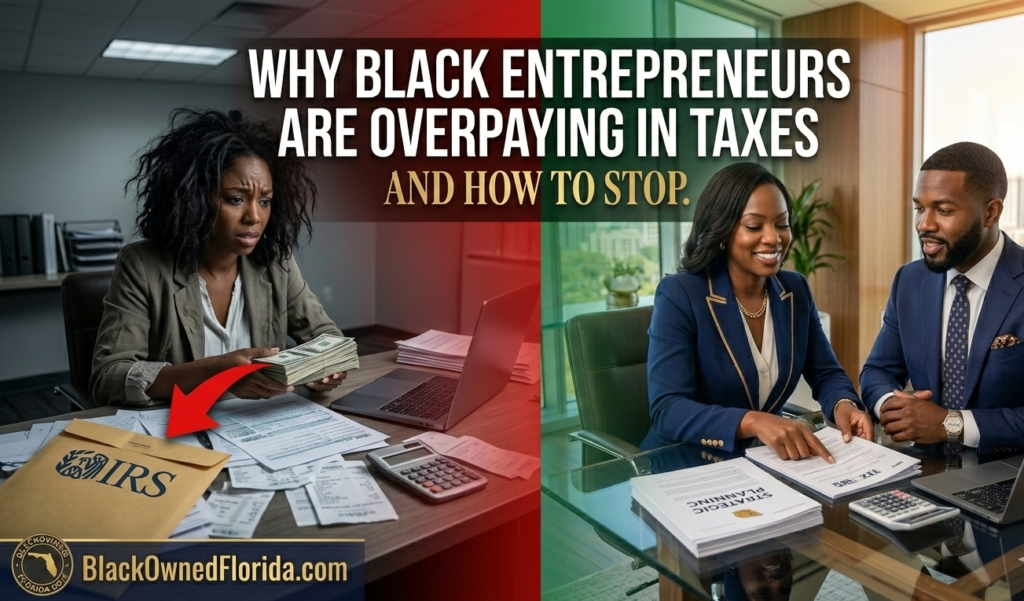
The exact reasons your tax bill is higher than it should be — and the proven fixes a Black tax expert uses to stop the bleeding for good.
The Silent Tax Drain Costing Black Entrepreneurs Thousands Every Year
If you are a Black entrepreneur in Florida and you have never had a dedicated tax professional review your return in depth, there is a strong chance you have been overpaying the IRS — year after year — without ever knowing it.
This is not a minor issue. In fact, research consistently shows that Black small business owners overpay in taxes at disproportionate rates compared to their white counterparts. Furthermore, this overpayment is rarely the result of dishonesty or carelessness. Rather, it stems from specific, identifiable mistakes — most of which are entirely fixable.
The good news is straightforward. Consequently, each of the problems outlined in this guide has a clear solution. Moreover, a qualified Black tax expert in Florida can implement every one of these fixes — often recovering thousands of dollars in the very first year.
| 40% of Black-owned businesses overpay taxes due to the wrong entity structure | $1,200+ average unclaimed refund Black taxpayers leave behind each year | $5,000–$15,000 typical annual tax overpayment corrected when switching to a Black tax expert |
| 💡 Who This Guide Is For This guide is for Black freelancers, gig workers, LLC owners, sole proprietors, S-Corp founders, content creators, contractors, real estate investors, and any Black entrepreneur in Florida who earns income outside of a traditional W-2 paycheck. If any of that describes you, read every word of what follows. |
💸 The Real Cost of Overpaying: A Quick Reference
See What Each Mistake Is Costing You
Before diving into the details of each issue, review this summary table. Specifically, it shows the most common overpayment mistakes, the estimated annual cost of each, and the fix a Black tax expert applies. Consequently, you will immediately see where the biggest opportunities for savings lie.
| Mistake | Est. Annual Cost | The Fix |
| Wrong entity structure | $5,000 – $15,000 | S-Corp election at the right income threshold |
| Missing home office deduction | $500 – $3,000 | Document and claim exclusive workspace |
| No retirement contributions | $2,000 – $8,000 | Open SEP-IRA or Solo 401(k) this year |
| Skipping Section 199A (QBI) | $2,000 – $7,000 | Claim up to 20% business income deduction |
| Under-counting vehicle mileage | $700 – $4,000 | Track every mile with a mileage app |
| Missing health insurance deduction | $600 – $3,600 | Deduct 100% of self-paid premiums |
| No quarterly tax planning | $1,000 – $5,000 | Year-round strategy with a Black tax expert |
| Using a seasonal chain preparer | $1,200 – $6,000 | Switch to a dedicated Black tax professional |
Reason #1: You Are Using the Wrong Business Entity Structure
The Most Expensive Mistake in Black Entrepreneurship
This is the single most costly tax mistake Black entrepreneurs make. In fact, it is responsible for more overpayment than any other issue on this list. However, it is also one of the most straightforward to fix once identified.
The problem is this: most Black entrepreneurs start as sole proprietors or single-member LLCs. As a result, all business profit is subject to both income tax and self-employment tax — currently 15.3% on the first $168,600 of net earnings. Consequently, a Black entrepreneur earning $100,000 in net profit as a sole proprietor can easily owe $15,000 or more in self-employment tax alone.
The S-Corp Solution — And Why It Works
However, there is a powerful alternative. By electing S-Corp tax status for their LLC or corporation, Black entrepreneurs can significantly reduce self-employment tax. Specifically, an S-Corp pays the owner a reasonable salary — which is subject to payroll tax. However, the remaining profit passes through as a distribution — and distributions are NOT subject to self-employment tax.
A Simple Example
| Scenario | Sole Proprietor | S-Corp Election |
| Net business profit | $120,000 | $120,000 |
| Reasonable owner salary | N/A | $60,000 |
| Profit distribution | N/A | $60,000 |
| Self-employment/payroll tax | ~$16,956 | ~$9,180 |
| Estimated SE tax savings | — | ~$7,776/year |
Therefore, in this example, the S-Corp election saves nearly $7,800 per year in self-employment tax alone. Furthermore, that savings compounds over time — meaning the earlier you make the switch, the more you benefit.
| 🔑 When Should You Make the S-Corp Election? Generally, the S-Corp election makes financial sense when your net business profit consistently exceeds $40,000 to $50,000 per year. Below that threshold, the administrative costs may outweigh the tax savings. However, every business is different. Consequently, a Black tax expert will calculate the exact breakeven point for your specific situation and make the recommendation at precisely the right time. |
Reason #2: You Are Not Claiming the Home Office Deduction
One of the Most Powerful Deductions — One of the Most Skipped
The home office deduction is among the most valuable write-offs available to Black entrepreneurs. Nevertheless, it remains one of the most consistently skipped. The reason is simple: many business owners fear it will trigger an audit. However, that fear is outdated and not supported by IRS data.
In reality, if you have a dedicated space in your home used regularly and exclusively for business, you have a legitimate and defensible deduction. Moreover, the IRS offers a simplified calculation method specifically to make this deduction more accessible.
What You Can Deduct — And How Much It Is Worth
- Simplified method: $5 per square foot, up to 300 square feet — a maximum $1,500 deduction per year
- Regular method: actual home expenses proportional to office square footage — typically yields $2,000 to $8,000+ per year
- Utilities — electric, internet, gas, and water — proportional to office size
- Rent or mortgage interest — the office percentage of your total housing cost
- Home insurance — the proportional business share
- Repairs and maintenance — for issues that affect the office space
The Rule That Trips People Up
The space must be used regularly and exclusively for business — period. Furthermore, it must be the principal place of your business. Therefore, a dedicated home office qualifies easily. However, a multipurpose guest room that also serves as an office does not qualify under the exclusive use test.
Consequently, many Black entrepreneurs inadvertently disqualify themselves by not understanding this rule clearly. However, a Black tax expert will walk you through the exact requirements and help you document your workspace correctly — so the deduction is airtight.
Reason #3: You Are Not Maximizing Retirement Contributions
The Wealthiest Black Entrepreneurs Use This Strategy Every Year
Retirement contributions are simultaneously the most effective legal tax shelter and the most underused wealth-building tool for Black entrepreneurs. Yet the majority of Black business owners in Florida contribute nothing — and overpay thousands in taxes as a result.
Here is why this matters so much. Specifically, every dollar you contribute to a qualifying retirement account reduces your taxable income by that same dollar amount. Therefore, contributing $20,000 to a SEP-IRA does not just build retirement wealth — it directly reduces your tax bill by $4,400 to $7,400 depending on your bracket.
The Three Best Retirement Accounts for Black Entrepreneurs
SEP-IRA — Simple and Powerful
A SEP-IRA allows contributions of up to 25% of net self-employment income — with a 2025 maximum of $69,000. Furthermore, it is easy to set up, requires no employees to maintain, and contributions can be made as late as your tax filing deadline. Consequently, it is the most popular choice for solo Black entrepreneurs.
Solo 401(k) — Even Higher Limits
A Solo 401(k) allows both employee and employer contributions. Specifically, the employee contribution limit is $23,500 in 2025 — plus an employer contribution of up to 25% of compensation. As a result, total contributions can exceed $70,000 annually — making it the most powerful option for high-earning Black entrepreneurs.
SIMPLE IRA — For Black Business Owners With Employees
If you have employees, a SIMPLE IRA allows contributions up to $16,500 in 2025. Moreover, it requires employer matching contributions — which are also fully deductible. Therefore, it serves both as a tax reduction tool and an employee retention benefit.
| $69,000 | maximum SEP-IRA contribution in 2025 — every dollar contributed directly reduces your taxable income and accelerates Black generational wealth |
Reason #4: You Are Missing the Section 199A QBI Deduction
A 20% Income Deduction Most Black Business Owners Never Claim
Section 199A of the tax code allows eligible pass-through business owners to deduct up to 20% of their qualified business income from their taxable income. Furthermore, this deduction is available to sole proprietors, LLCs, S-Corps, and partnerships. Consequently, it is one of the most broadly applicable deductions in the entire tax code.
Nevertheless, a significant number of Black entrepreneurs either do not know it exists or are not claiming it correctly. As a result, they pay taxes on income that could have been legally excluded.
The Numbers Behind the Deduction
- Net business income of $80,000 → potential deduction of $16,000 → tax savings of $3,520 to $5,920
- Net business income of $120,000 → potential deduction of $24,000 → tax savings of $5,280 to $8,880
- Net business income of $200,000 → potential deduction of $40,000 → tax savings of $8,800 to $14,800
However, there are income thresholds and phase-outs — particularly for specified service trades or businesses (SSTBs). Moreover, W-2 wage limitations apply above certain income levels. Therefore, this deduction is complex enough that attempting it without a Black tax expert often results in errors — either underclaiming or triggering IRS scrutiny.
| 💰 Do Not Leave 20% of Your Income Unprotected The Section 199A deduction is arguably the most valuable provision in the tax code for Black entrepreneurs. However, it requires precise calculation and correct documentation. A Black tax expert not only claims it correctly — they also structure your business operations to maximize your eligibility. Find yours at BlackOwnedFlorida.com. |
Reason #5: You Are Not Tracking Business Vehicle Mileage
Thousands of Dollars Driven Away Every Year
Vehicle expenses represent one of the most consistently underreported deductions for Black entrepreneurs. Specifically, most business owners who use their personal vehicle for business purposes dramatically undercount their actual business mileage. As a result, they leave hundreds — or thousands — of dollars in legitimate deductions unclaimed every year.
What the Numbers Look Like in 2025
The IRS standard mileage rate for 2025 is 70 cents per mile. Therefore, consider these examples of what business driving is actually worth:
- 5,000 business miles = $3,500 deduction
- 10,000 business miles = $7,000 deduction
- 15,000 business miles = $10,500 deduction
- 20,000 business miles = $14,000 deduction
Furthermore, any Black entrepreneur who regularly drives to meet clients, make deliveries, purchase supplies, attend networking events, or travel between business locations is almost certainly logging more business miles than they realize.
The Documentation Requirement — Do Not Skip This Step
The IRS requires contemporaneous records of business mileage — meaning you must track miles as you drive, not reconstruct them later from memory. Consequently, a mileage tracking app is essential. Specifically, apps like MileIQ, Everlance, or TripLog log every drive automatically and classify trips with a simple swipe.
Moreover, proper documentation protects you in an audit. Without records, the IRS can disallow the entire vehicle deduction — regardless of how legitimate your actual business driving was. Therefore, starting a mileage log today is one of the highest-ROI actions any Black entrepreneur can take.
Reason #6: You Are Skipping the Self-Employed Health Insurance Deduction
100% Deductible — and Almost Nobody Claims It
If you pay for your own health, dental, or vision insurance as a self-employed person, you can deduct 100% of those premiums directly from your gross income. Furthermore, this is an above-the-line deduction — meaning you do not need to itemize to claim it. Nevertheless, a remarkable number of Black entrepreneurs simply do not know this deduction exists.
For context, consider the numbers. Specifically, a Black entrepreneur paying $500 per month in health insurance premiums has a $6,000 annual deduction. Consequently, at a 22% federal tax rate, that is $1,320 in tax savings from a single deduction that requires almost no additional effort to claim.
Three Conditions to Qualify
- You must be self-employed — as a sole proprietor, LLC owner, S-Corp owner, or partner
- You must not be eligible for employer-subsidized coverage through a spouse’s employer
- The premium amount deducted cannot exceed your net self-employment income for the year
Moreover, this deduction covers not just your own premiums but also coverage for your spouse, dependents, and children under age 27. Therefore, the potential deduction amount can be significantly larger than most Black entrepreneurs initially estimate.
Reason #7: You Have No Year-Round Tax Strategy
Filing and Forgetting Is the Most Expensive Habit in Business
Perhaps the most pervasive — and most costly — mistake Black entrepreneurs make is treating taxes as a once-a-year event. Specifically, they wait until January or February, gather documents in a rush, file by April 15, and then forget about taxes until the following year. Consequently, they miss dozens of planning opportunities that could have reduced their bill significantly.
By contrast, wealthy entrepreneurs — of all backgrounds — treat tax strategy as a year-round discipline. Furthermore, the most valuable tax decisions are not made at filing time. Rather, they are made in March, July, October, and December — when there is still time to act.
What Year-Round Tax Planning Actually Looks Like
- Q1 (January – March): Review prior year results, assess entity structure, plan retirement contributions
- Q2 (April – June): File or extend returns, set up quarterly estimated payments, review income trajectory
- Q3 (July – September): Mid-year income review, adjust estimated payments, evaluate equipment purchase timing
- Q4 (October – December): Year-end income acceleration or deferral, maximize retirement contributions, charitable giving strategy, harvest investment losses
Moreover, a Black tax expert who provides year-round access does not just save you money at filing time. In fact, they prevent costly mistakes before they happen. As a result, the relationship pays for itself many times over — not just through deductions, but through proactive guidance that keeps your business financially healthy all year long.
Reason #8: You Are Using a Seasonal Preparer Who Does Not Know Your Business
Volume-Driven Tax Preparation Is the Enemy of Black Wealth
This may be the most important reason on this entire list. Specifically, the type of tax professional you use has a more direct impact on your tax bill than almost any other single factor. Nevertheless, many Black entrepreneurs continue using seasonal chain preparers — simply out of habit or convenience.
Here is the core problem. Seasonal tax preparers at big box chains are trained to process returns efficiently — not to optimize them strategically. Furthermore, a different preparer may handle your return each year. As a result, there is no continuity, no deep understanding of your business, and no proactive advice.
What You Lose Every Year With the Wrong Preparer
- 💸 Missed deductions — the preparer only claims what you explicitly bring up
- 💸 Wrong entity structure — no one has reviewed whether your LLC should elect S-Corp
- 💸 No retirement advice — no one has mentioned your SEP-IRA or Solo 401(k) options
- 💸 Zero year-round planning — the relationship ends the moment your return is filed
- 💸 No IRS representation — if you receive a notice in July, you are largely on your own
- 💸 Cultural disconnect — your business model and community context are unfamiliar
The Alternative: A Dedicated Black Tax Expert
By contrast, a dedicated Black tax expert in Florida knows your name, your business, your goals, and your history. Furthermore, they proactively identify opportunities throughout the year. As a result, your tax return is not just a filing — it is the culmination of a year-round wealth-building strategy.
| ✊🏾 The Relationship Is the Strategy The Black entrepreneurs in Florida who pay the least in taxes are not doing anything illegal. They are simply working with a Black tax expert who knows them, plans with them year-round, and fights for every dollar the law allows. That relationship is worth far more than the fee — and it compounds in value every single year. |
✅ The Complete Fix — Your Action Plan
Eight Steps to Stop Overpaying Starting This Year
Each problem outlined in this guide has a clear, actionable solution. Furthermore, none of these fixes require anything complicated or aggressive. Rather, they simply require working with the right professional and taking the right actions at the right time. Consequently, here is your complete action plan.
Fix #1: Get a Prior-Year Return Review
Find Out How Much You Have Already Overpaid
First, ask a Black tax expert to review your last two or three tax returns. Specifically, request that they look for missed deductions, entity structure opportunities, and credits you did not claim. Moreover, if they find errors, you can file amended returns going back up to three years. Therefore, recovery is possible even for money already sent to the IRS.
Fix #2: Evaluate Your Entity Structure Now
Do Not Wait Until Next Tax Season to Make the Switch
Specifically, ask your Black tax expert to compare your current structure — sole proprietor or LLC — against S-Corp tax treatment at your current income level. Furthermore, if the S-Corp election makes sense, the election can often be made retroactively for the current tax year. Consequently, you do not have to wait until January to benefit.
Fix #3: Open a Retirement Account Before December 31
Every Dollar Contributed This Year Reduces This Year’s Tax Bill
Opening a SEP-IRA or Solo 401(k) before year-end is one of the highest-impact tax actions any Black entrepreneur can take. Furthermore, SEP-IRA contributions can be made as late as your tax filing deadline — including extensions. Therefore, even if you start late, you can still reduce this year’s tax liability significantly.
Fix #4: Start Tracking Mileage Today
This Takes 30 Seconds Per Trip — and Pays for Itself Immediately
Download a mileage tracking app and activate it today. Specifically, MileIQ, Everlance, and TripLog all offer automatic tracking that logs every drive in the background. Moreover, you can classify trips as business or personal with a single swipe. Consequently, by December 31, you will have a complete, IRS-compliant mileage log — ready for your Black tax expert to use.
Fix #5: Claim Your Home Office Deduction
Document Your Workspace Before the Year Ends
Measure your dedicated office space and photograph it. Furthermore, note the total square footage of your home for comparison. Specifically, if your 150-square-foot office sits in a 1,500-square-foot home, 10% of your eligible home expenses become deductible. Therefore, document this now — before year-end — to ensure the deduction applies to the current tax year.
Fix #6: Schedule a Year-End Planning Session in November or December
The Most Valuable Tax Meeting Is the One Before December 31
December is the last month you can legally reduce your current year’s tax bill. Specifically, actions taken on January 1 are too late for the prior year. Therefore, scheduling a year-end planning session with a Black tax expert in November or December is one of the highest-value calendar entries any Black entrepreneur can make.
| 📅 Book Before December 31 — Not April 14 The single most important tax appointment of the year is not your April filing appointment — it is your November or December planning session. At that point, you still have time to make retirement contributions, defer income, accelerate deductions, and adjust your business structure. After December 31, those options close. Book your planning session with a Black tax expert at BlackOwnedFlorida.com today. |
📊 Before and After: What Changes With a Black Tax Expert
A Side-by-Side Look at the Real Difference
To summarize, here is a direct comparison of the tax experience for a typical Black entrepreneur — before and after working with a dedicated Black tax expert. Consequently, the difference is not just financial. Rather, it is structural, strategic, and long-term.
| Situation | ❌ Without Fix | ✅ With Black Tax Expert |
| Entity structure | Sole proprietor — paying 15.3% SE tax on all profit | S-Corp election — SE tax only on reasonable salary |
| Retirement contributions | None — full profit is taxable | SEP-IRA funded — $20,000+ removed from taxable income |
| Home office | Not claimed — fear of audit | Properly documented and claimed — $2,000–$5,000 deduction |
| Vehicle mileage | Rough estimate or nothing claimed | Every mile tracked — $3,000–$10,000 deduction |
| Section 199A | Not claimed — unaware it exists | Full 20% QBI deduction applied correctly |
| Health insurance | Premiums paid with after-tax dollars | 100% of premiums deducted above the line |
| Tax planning | One appointment in April — reactive | Year-round strategy — proactive and wealth-focused |
| IRS notices | Handled alone — stressful and costly | Tax expert responds on your behalf immediately |
Frequently Asked Questions
How do I know if I am overpaying in taxes right now?
The most reliable way is to have a Black tax expert review your last two or three returns. Specifically, look for missing deductions, wrong entity structure, and unclaimed credits. Furthermore, if you have never had a dedicated tax professional — as opposed to a seasonal preparer — review your returns in depth, there is a high probability that overpayment has occurred.
Can I recover taxes I overpaid in previous years?
Yes. If you overpaid due to missed deductions or errors, you can file an amended return (Form 1040-X) for up to three years from the original filing date. Consequently, recovery is not just possible — it is something many Black tax experts actively help clients pursue. Therefore, prior-year return reviews have a direct and immediate financial payoff.
What is the first thing I should do after reading this guide?
The first step is to find a Black tax expert in Florida and schedule a consultation. Moreover, bring your last two tax returns to that first appointment. Specifically, ask the professional to identify missed deductions, review your entity structure, and recommend a retirement contribution strategy. Furthermore, ask about year-round availability — not just filing season support.
Is the S-Corp election right for every Black entrepreneur?
Not necessarily. The S-Corp election makes the most financial sense when net business profit consistently exceeds $40,000 to $50,000 per year. Below that level, the administrative costs — including payroll processing — may offset the tax savings. Therefore, a Black tax expert will calculate the exact threshold for your specific business before recommending the switch.
How much does it cost to work with a Black tax expert in Florida?
Fees vary based on complexity. However, most Black tax preparers in Florida charge between $250 and $600 for individual returns with business income — and $500 to $1,500 for business returns with planning. Furthermore, the typical first-year client recovers $3,000 to $15,000 in previously missed deductions. Consequently, the return on investment is substantial from day one.
Stop Overpaying. Start Keeping More.
Every year you wait is another year the IRS keeps money that belongs to you.
Find your Black tax expert in Florida today at BlackOwnedFlorida.com.
| 🔍 Find Black Tax Experts BlackOwnedFlorida.com /black-tax-experts | 📋 Black Tax Preparers BlackOwnedFlorida.com /black-tax-preparers | 🧮 Free Tax Estimate TaxEstimator.pro |
BlackOwnedFlorida.com Florida’s Premier Directory of Black-Owned Businesses & Professionals