
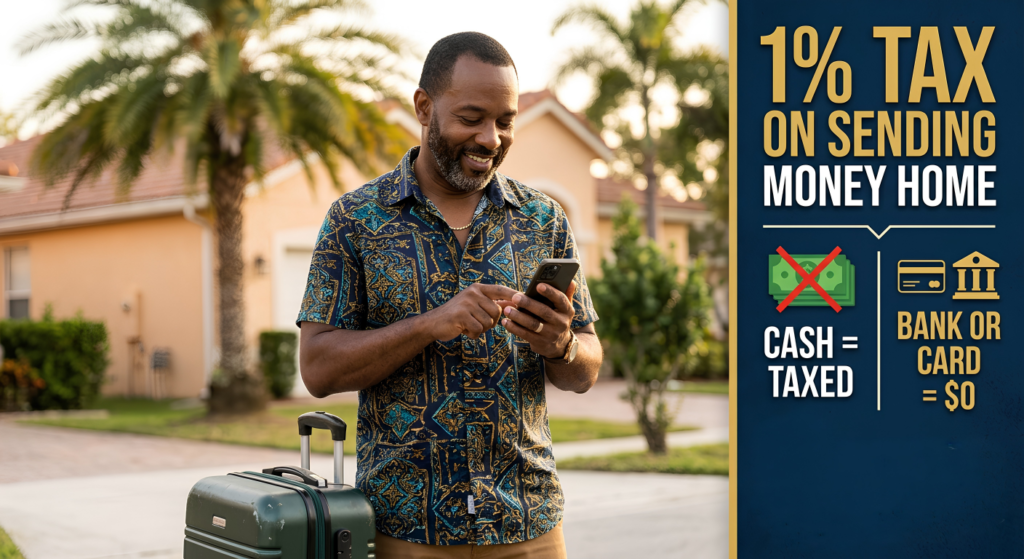
The 1% Remittance Tax: How to Send Money Home for Less
For Florida’s Jamaican, Haitian, Bahamian, Trinidadian, and other immigrant families, sending money home is not a luxury. It is rent, school fees, and medicine. Here is how the new tax works and how to avoid paying it.
If you send money to a mother in Kingston, a brother in Port-au-Prince, or a cousin in Nassau, you already know the math is never simple. The transfer fee, the exchange rate, the pickup location. Now there is one more line. A 1% federal excise tax on certain remittance transfers took effect on January 1, 2026. The good news is that for most people it is easy to avoid, and the way to avoid it also tends to save you money on fees. The families who know this keep more of every dollar for the people who depend on it.
What the Remittance Tax Is
The tax comes from the 2025 federal budget law, and Treasury and the IRS issued proposed regulations in April 2026 to explain how it works. Transfer companies must collect the tax from certain senders and send it to the IRS. If a company fails to collect it, the company becomes responsible for it. Because the regulations were still proposed at the time of writing, details can be refined, so keep an eye on updates.
Who Actually Pays It, and Who Does Not
| How you pay | 1% tax? | Cost on $500 |
|---|---|---|
| Cash at an agent location | Yes | $5.00 |
| Money order or cashier’s check | Yes | $5.00 |
| U.S. bank account (ACH or debit) | No | $0 |
| U.S.-issued debit or credit card | No | $0 |
The difference is small per transfer, but families who send every month feel it. Someone sending $400 in cash each month pays about $48 a year in tax alone, on top of fees. That is a few weeks of groceries for the person receiving it.
How to Avoid the Tax Without Losing Access
If you do not have a bank account, you are not alone, and that is where the tax can hit hardest. A basic checking account at a bank or credit union is often enough. Many banks and credit unions in Florida accept ITIN holders. Ask directly. If you are working toward owning a home or building credit, having a bank account also starts the paper trail lenders need. A Black-owned financial advisor can help you set up a simple system for sending money home and building your own savings at the same time.
Watch for the real cost: exchange rate markups can cost much more than 1%. Compare the total amount the receiver gets, not just the advertised fee, across at least two or three licensed providers. And only use licensed providers. Informal cash couriers may feel convenient, but you have no protection if the money disappears.
Keep Records, and Ask About Your Taxes
Some sources describe the tax as non-refundable, and the rules could be refined as the regulations are finalized. A good Black-owned tax preparer can tell you how it applies to your situation. If you support family members abroad, also ask whether dependent or other filing rules apply to you. This is also relevant to business owners who pay overseas suppliers or contractors in cash, so ask about both personal and business transfers.
Remittance Tax Savings Calculator
Enter what you send and how often to see what the 1% costs over a year if paid in cash.
Send-Home-Smarter Checklist
Make every dollar you send go further.
Find a Black-owned Florida tax preparer who can explain how the new rules apply to your family.
Find a Black Tax PreparerFrequently Asked Questions
What is the new remittance tax?
It is a 1% federal excise tax on remittances sent from the U.S. to recipients abroad when the sender pays with cash, a money order, a cashier’s check, or a similar physical instrument. It took effect January 1, 2026.
Do I pay the remittance tax if I send money from my bank account?
No. Transfers funded from a U.S. bank account or with a debit or credit card issued in the U.S. are exempt from the 1% tax, regardless of the amount.
How much does the remittance tax cost?
It is 1% of the transfer amount. That is $2 on $200, $5 on $500, and $10 on $1,000 when funded with cash, in addition to the provider’s normal fees and exchange-rate costs.
Can I get the remittance tax back on my tax return?
Some sources describe it as non-refundable with no credit, and the regulations are still being refined. Ask a tax professional how it applies to your situation, and treat the 1% as a cost unless they confirm otherwise.
Can I open a bank account without a Social Security number?
Many banks and credit unions accept an ITIN for opening an account, though policies vary by institution. Ask directly and compare more than one. Having an account also lets you avoid the cash-funded remittance tax.
This article is general educational information, not tax or legal advice. Rules and regulations can change. Confirm current details with a qualified tax professional.