
You Built the Business. Who’s Protecting It?
Nearly three out of four small businesses are uninsured or underinsured — and coverage often drops off right after the first year, exactly when there’s more to lose. Here’s what to actually carry.
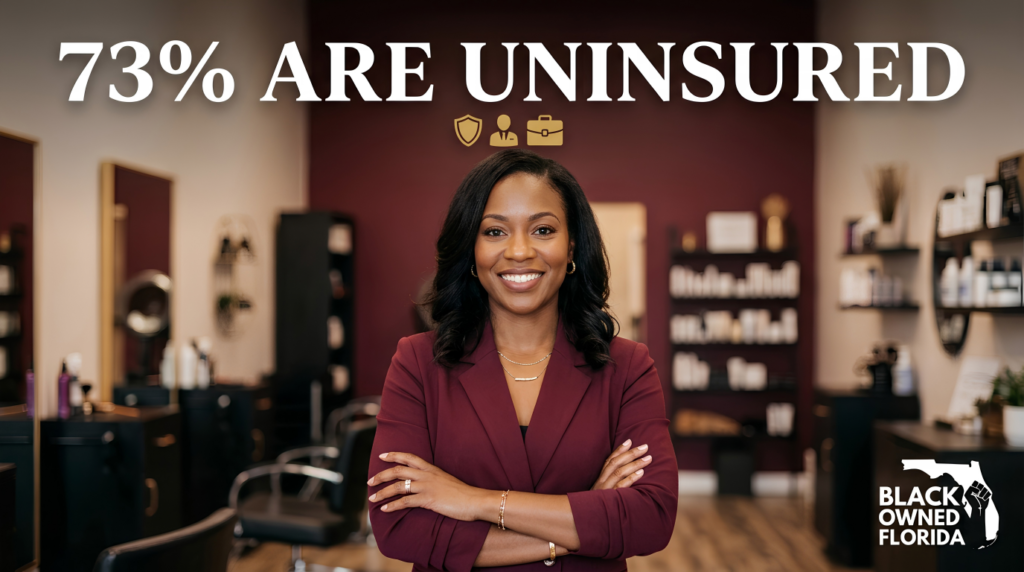
You didn’t build a business to lose it to a slip-and-fall claim you never saw coming, a client dispute over work you delivered in good faith, or a fire that a landlord’s policy never covered because it only protects the building, not your equipment or inventory inside it. And yet a recent national survey found that 73% of small businesses are either completely uninsured or carrying coverage that wouldn’t hold up against their actual risks. If you’re a Black-owned business in Florida — often self-funded, often bootstrapped, often making every dollar count — this is the conversation nobody has with you until it’s too late.
Why the Insurance Gap Gets Wider, Not Narrower, Over Time
This is the opposite of what you’d expect, and it’s exactly backwards from how risk actually works. In year one, most new owners buy a basic policy because a landlord, a bank, or a licensing board required it as a condition of doing business. But once that policy is in place and nothing bad has happened, renewal becomes an afterthought — especially when cash flow is tight and insurance feels like the easiest line item to defer. Meanwhile, the business has grown: more clients, more employees, more equipment, more physical space — and more exposure if something goes wrong.
The Three Policies Every Florida Small Business Actually Needs
General liability is the floor, not the ceiling — it covers a customer slipping in your salon, a client’s laptop getting damaged during a repair, or a vendor claiming your booth damaged their space at a pop-up market. Commercial property insurance covers what’s inside your four walls: your chairs, your ovens, your inventory, your laptops — none of which your landlord’s policy touches. And professional liability (errors & omissions) matters enormously for consultants, accountants, real estate agents, contractors, and anyone whose business is built on advice or expertise — a dissatisfied client claiming your advice cost them money is a lawsuit general liability was never designed to cover.
What This Actually Costs (and Why “I Can’t Afford It” Usually Has the Math Backwards)
The businesses that skip insurance almost always frame it as a cost they can’t take on right now. But the right frame is a comparison: a general liability policy for a typical Florida salon, contractor, consultant, or retail storefront usually runs somewhere between $400 and $1,200 a year, paid monthly in many cases for under $100. Compare that to a single slip-and-fall claim, which routinely runs into the tens of thousands once medical costs and legal fees are involved — money that comes directly out of the business owner’s pocket, savings, or in the worst cases, personal assets, if the business isn’t properly separated and insured.
Protecting What You’re Building for the Next Generation
A single uninsured claim doesn’t just cost money — it can end a business outright, along with every year of equity built toward passing it on. If part of your goal (like a lot of the founders in this directory) is building something that outlives your daily involvement in it, insurance is the unglamorous piece of infrastructure that makes that possible. It’s the difference between a bad year and a business-ending one.
✅ Business Insurance Readiness Checklist
Check off what you already have. See what’s missing before it costs you.
Don’t guess at what your business actually needs covered.
Talk to a Black-owned Florida insurance agency that can quote general liability, property, and E&O together.
Find a Black-Owned Insurance Agency →Frequently Asked Questions
Do I legally need business insurance in Florida?
Florida doesn’t require general liability insurance for most businesses by law, but it does require workers’ compensation for most businesses with four or more employees (one or more in construction), and many landlords, licensing boards, and client contracts require proof of general liability as a condition of doing business.
What’s the difference between general liability and professional liability insurance?
General liability covers third-party bodily injury and property damage claims — like a customer slipping in your store. Professional liability (errors & omissions) covers claims that your advice, services, or expertise caused a client financial harm — relevant for consultants, agents, accountants, and service-based businesses.
How much does small business insurance cost in Florida?
A general liability policy for a typical small service business commonly runs $400–$1,200 per year, though the exact cost depends on your industry, revenue, location, and claims history. Bundling general liability, property, and professional liability into a Business Owner’s Policy (BOP) is often more affordable than buying each separately.
Why do so many small businesses go without insurance?
National survey data shows 73% of small businesses are uninsured or underinsured, and coverage rates actually drop from 82% in year one to 67% by years one through five — often because owners deprioritize renewing or expanding coverage as cash flow tightens, even as their risk exposure grows with the business.
Does my landlord’s insurance cover my business’s equipment and inventory?
No. A landlord’s commercial property policy typically covers only the physical building structure. Your equipment, inventory, furniture, and business property inside the space are not covered unless you carry your own commercial property insurance.