
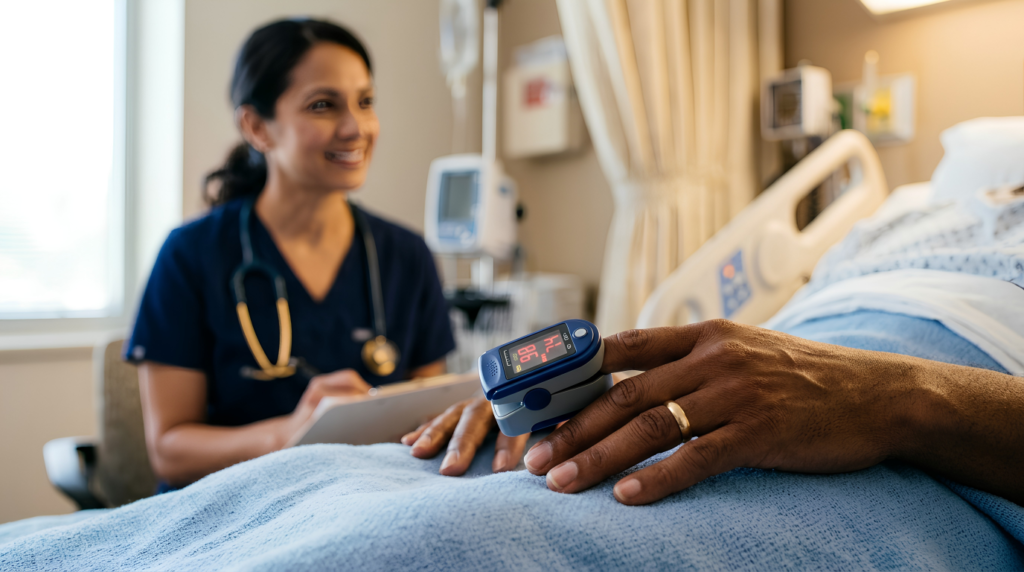
The Little Clip on Your Finger Might Be Telling Your Doctor You’re Fine When You’re Not
Pulse oximeters, the small devices clipped to a finger to measure blood oxygen, have a documented accuracy problem on darker skin. Here’s what the science actually shows, and what to do with that information.
If you’ve ever felt genuinely short of breath while a pulse oximeter reading said you were fine, you weren’t imagining it, and you weren’t overreacting. A body of medical research going back more than three decades, and confirmed again in a major 2020 study, has found that pulse oximeters systematically overestimate blood oxygen levels in people with darker skin, sometimes hiding a dangerously low reading behind a number that looks normal.
Find a Black Doctor →
How can I know if my pulse oximeter reading is accurate for my skin tone?
The device itself gives no warning that anything is off. It simply displays a number, and that number can be wrong in a specific, predictable direction: too high. This means the tool designed to catch a dangerous situation can instead mask it, at exactly the moment accurate information matters most.
What is occult hypoxemia, and why does it disproportionately affect Black patients?
The reason traces back to how the devices work: they shine light through the skin and measure how much is absorbed. Melanin, the pigment responsible for darker skin tones, absorbs some of that light too, and older device calibrations, largely built and tested on lighter-skinned populations, didn’t fully account for that interference. A 2020 Stanford-affiliated study published in the Proceedings of the National Academy of Sciences went further, finding this bias didn’t just produce a wrong number. It measurably reduced the follow-up care Black patients received compared to white patients with the same displayed reading.
Are newer AI health wearables, like smartwatches and rings, any better?
It’s tempting to assume that newer, AI-powered consumer devices, the health features built into smartwatches and rings, have solved this by now. The honest answer, based on the most current research available, is that the picture remains unresolved. A 2026 FDA-commissioned study meant to finally settle the question actually produced surprising, inconclusive results, meaning clinicians and consumers alike are still working without a fully validated fix.
What can I actually do about this today?
- Report symptoms, not just numbers. If you feel short of breath, confused, or unusually fatigued, say so clearly, even if the device reads normal.
- Ask specifically about arterial blood gas testing if you’re in a hospital setting and something feels wrong, this is the more accurate, direct measurement pulse oximeters were designed to estimate.
- Don’t self-diagnose off a home device alone during a genuine health concern; use it as one data point, not the whole picture.
- Build a relationship with a doctor who takes your reported symptoms seriously, not just the equipment’s output.
✅ Free Tool: “Know Your Numbers” Symptom Check
This is educational, not a diagnostic tool. If you’re having a medical emergency, call 911 or go to an ER regardless of any device reading.
Frequently Asked Questions
Do pulse oximeters really work differently on darker skin?
Yes, research spanning more than three decades has found that pulse oximeters can overestimate blood oxygen saturation in patients with darker skin tones, sometimes masking dangerously low levels.
What is occult hypoxemia?
Occult hypoxemia is when a pulse oximeter displays a normal or near-normal reading while a patient’s true blood oxygen level, measured directly, is dangerously low.
Has this problem been fixed in newer devices?
Not fully. A 2026 FDA-commissioned study intended to clarify the issue produced surprising, inconclusive results, and researchers have not yet reached a validated, settled fix.
What should I do if I feel short of breath but my device reads normal?
Report your symptoms clearly to a medical provider regardless of the device reading, and ask about more direct testing such as arterial blood gas measurement if something feels seriously wrong.
Browse the Directory →