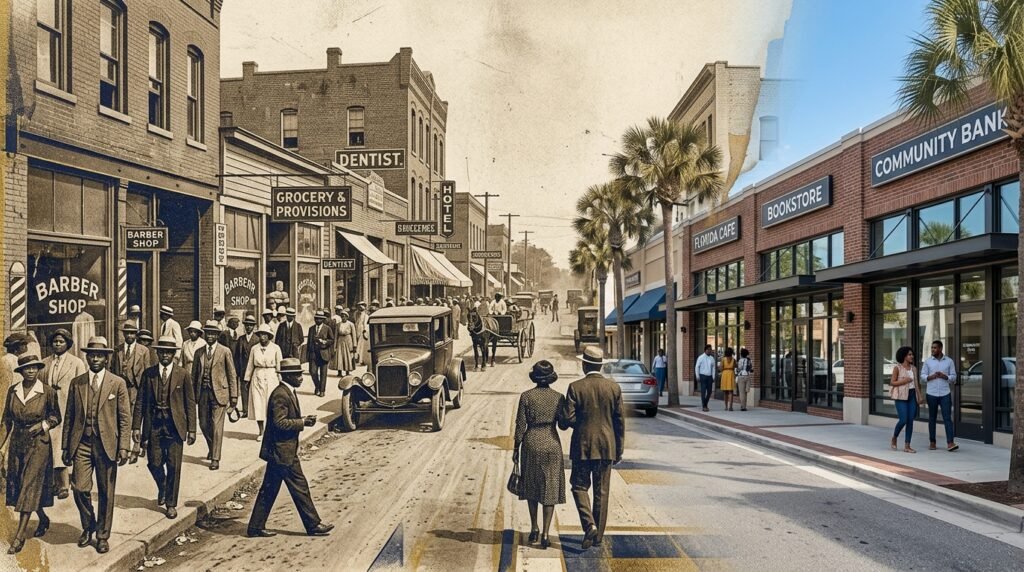
This Wasn’t Theoretical. It Was a Whole Street, Full of Us, Thriving.
Before it was ever a slogan, “Black business district” was a real place in Florida — with doctors, lawyers, libraries, and nightclubs that hosted Ella Fitzgerald and Ray Charles. Here’s the throughline from then to now.
There’s a particular kind of loneliness in being “the first” — the first in your family to open a business, the first Black face in a boardroom, the first to attempt something with no one to call who’s done it before. It can feel like you’re inventing the possibility from nothing. You’re not. You’re picking back up something Florida’s Black community was already building, at scale, generations ago.
Psychologists have a name for what happens when you can actually see someone who looks like you succeeding at what you’re attempting: it changes what your brain believes is possible, not just what you hope is possible. Researchers studying entrepreneurship consistently find that visible role models measurably shift whether someone believes starting a business is even a realistic option for them. Representation isn’t a feel-good extra. It’s a functional ingredient in whether people take the leap at all.
Browse the Directory →
Three Places That Prove It Wasn’t Theoretical
Central Avenue, Tampa — “Harlem of the South”
From the 1890s through the 1950s, Central Avenue was the beating heart of Black commercial and cultural life in Tampa. At its height, more than 200 Black-owned businesses lined the street — physicians, attorneys, insurance companies, and the Robert W. Saunders Sr. Public Library, Tampa’s first library for Black residents. Urban redevelopment razed most of it in the 1970s, but the history is preserved today at Tampa’s Black History Museum and Perry Harvey Sr. Park.
LaVilla, Jacksonville — one of the South’s “Harlems”
One of Jacksonville’s oldest historically African American neighborhoods, LaVilla became a nationally recognized center of Black music, business, and culture, drawing comparisons to New York’s Harlem during its own golden era.
The Styx, Palm Beach
Built by African American workers recruited to construct Henry Flagler’s railroad and grand hotels in the 1890s, The Styx grew into a self-sufficient community of nearly 2,000 residents — proof of what was built even under the harshest constraints of the era.
The Psychological Weight of Being “The First”
If you’ve ever felt the specific pressure of being the only one in the room, that feeling has a name in the research: it’s the burden of low “endowment via exposure” — simply not having grown up surrounded by visible proof that people who look like you already do the thing you’re attempting. It’s not a personal weakness. It’s an environmental gap, and it’s one that’s closing every time a local storefront, a listed professional, or a directory profile makes success visible again.
The Legacy Isn’t History — It’s Down the Street
Florida is home to more Black-owned businesses than any other state in the country today — over 21,000 and growing. Every one of them is a modern extension of Central Avenue, LaVilla, and The Styx: proof, in real time, that this has never been theoretical. The realtor closing deals in Orlando, the attorney handling estates in Tallahassee, the physician building a practice in Miami — they’re not exceptions. They’re the current chapter of a very old, very real story.
✅ Free Tool: The “Endowment via Exposure” Checklist
Small, concrete ways to build visible representation for the next generation — check off what you’re already doing.
Frequently Asked Questions
Where were Florida’s major historic Black business districts?
Notable historic districts include Central Avenue in Tampa (known as the “Harlem of the South”), LaVilla in Jacksonville, and The Styx in Palm Beach.
What happened to Tampa’s Central Avenue?
Urban redevelopment razed most of the district’s buildings in the 1970s, converting the area into a park, though its history is preserved through markers, museums, and Perry Harvey Sr. Park.
Does seeing a role model of the same background actually affect entrepreneurship?
Research on entrepreneurial role models consistently finds they measurably increase a person’s belief that starting a business is a realistic, achievable option.
How many Black-owned businesses are there in Florida today?
Florida is home to more than 21,000 Black-owned businesses, more than any other state in the country.
How can I find Black-owned businesses and professionals in Florida today?
BlackOwnedFlorida.com maintains a statewide directory of Black-owned businesses and professionals across Florida.
List Your Business →