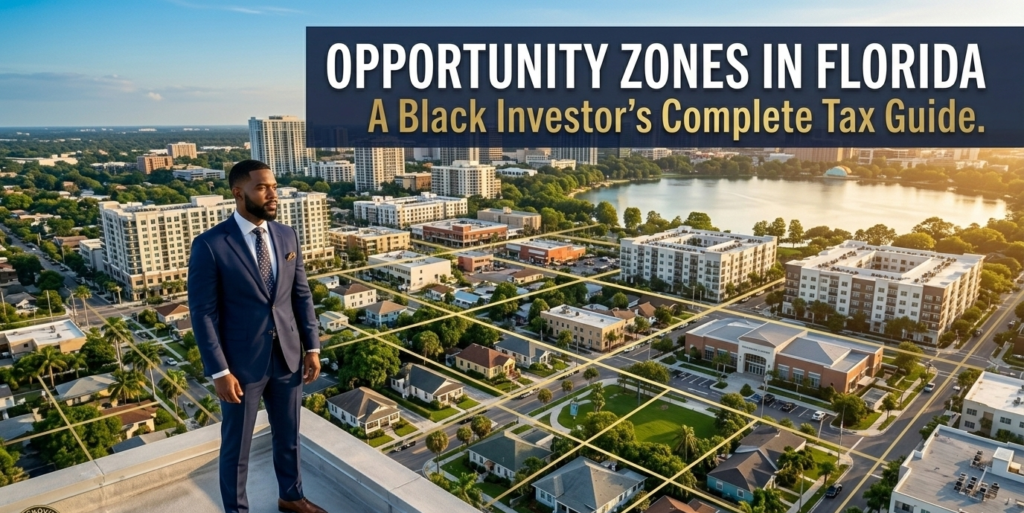
How to defer capital gains, eliminate taxes on new investment growth, and build generational wealth in Florida’s most powerful investment program — with a Black tax expert by your side.
The Most Powerful Wealth-Building Tool Most Black Investors Have Never Used
There is a federal investment program that allows you to defer taxes on capital gains, potentially reduce what you owe, and eliminate taxes on new investment profits entirely — and it was specifically designed to channel investment into communities like yours.
That program is the Qualified Opportunity Zone initiative. Furthermore, Florida has more than 400 designated Opportunity Zones. Significantly, many of these zones are located in historically Black communities across Miami, Orlando, Tampa, Jacksonville, and beyond.
However, most Black investors in Florida have never used this program. As a result, they continue paying full capital gains taxes that could have been deferred or eliminated entirely. This guide changes that. Moreover, a qualified Black tax expert in Florida can help you structure every step correctly — so you capture the full benefit the law provides.
| 400+ Designated Opportunity Zones in Florida | $75B+ Invested in Opportunity Zones nationwide since 2018 | 0% Capital gains tax on QOF investment growth held 10+ years |
| 💡 Who This Guide Is For This guide is for Black investors, entrepreneurs, and business owners in Florida who have sold — or plan to sell — a business, property, stocks, or any appreciated asset. If you are sitting on a capital gain, or expect one soon, Opportunity Zone investing could save you tens of thousands of dollars in taxes while building wealth in Black communities across the state. |
📖 What Is a Qualified Opportunity Zone?
The Origin of the Program
The Opportunity Zone program was created by the Tax Cuts and Jobs Act of 2017. Specifically, it was designed to stimulate long-term investment in low-income and underserved communities across the United States. As a result, governors of each state nominated eligible census tracts. Subsequently, the U.S. Treasury designated those tracts as Qualified Opportunity Zones.
In Florida, over 400 census tracts received this designation. Furthermore, many of these tracts include neighborhoods with significant Black populations — communities that have historically been overlooked by mainstream investment capital.
How the Program Works — The Core Mechanics
The Opportunity Zone program works through a specific investment vehicle called a Qualified Opportunity Fund (QOF). Consequently, to access the tax benefits, you must invest your eligible capital gains into a QOF within 180 days of realizing the gain.
Moreover, the QOF then deploys that capital into qualifying property or businesses located within a designated Opportunity Zone. As a result, your investment directly supports economic development in underserved communities — including many Black Florida neighborhoods.
The Three Tax Benefits — A Clear Breakdown
| # | Benefit | What It Means for You |
| 1 | Capital Gains Deferral | You delay paying taxes on your original capital gain until December 31, 2026. As a result, that deferred money stays invested and working for you instead of going to the IRS now. |
| 2 | Step-Up in Basis | If you hold your QOF investment for at least 5 years before Dec 31, 2026, your basis increases by 10%. Consequently, you owe taxes on less of your original gain when it eventually comes due. |
| 3 | Tax-Free Growth | If you hold your QOF investment for at least 10 years, ALL appreciation on the QOF investment itself is permanently excluded from taxation. Therefore, your new investment growth is completely tax-free. |
📍 Florida’s Opportunity Zones: Where Black Communities Win
Over 400 Zones — Many in Historically Black Florida Neighborhoods
Florida has one of the largest concentrations of Opportunity Zones in the United States. Furthermore, many of these zones are located in communities with deep Black historical roots. Therefore, Black investors who invest in these zones do two things simultaneously: they build personal wealth and reinvest in their own communities.
Consequently, this program represents a rare alignment of personal financial interest and community development. In other words, the best investment for your portfolio can also be the best investment for your neighborhood.
Florida Opportunity Zones by Metro Area
| Metro Area | OZ Count | Key Black Communities & Neighborhoods |
| Miami-Dade County | 67+ | Liberty City, Overtown, Little Haiti, Opa-locka, Perrine, Richmond Heights |
| Broward County | 30+ | Lauderdale Lakes, Pompano Beach, Deerfield Beach, Lauderhill, Margate |
| Orange County (Orlando) | 25+ | Parramore, Pine Hills, Eatonville (America’s first Black municipality), Apopka |
| Hillsborough (Tampa) | 30+ | East Tampa, Sulphur Springs, Ybor City, Progress Village, Plant City |
| Jacksonville (Duval) | 35+ | LaVilla, Durkeeville, Brentwood, Moncrief, Jacksonville Heights |
| Palm Beach County | 20+ | Riviera Beach, Belle Glade, Pahokee, Lake Worth, Westgate |
| Polk County | 15+ | Lakeland, Winter Haven, Bartow, Haines City |
| Leon County (Tallahassee) | 10+ | Frenchtown, South City, Bond neighborhood, Griffin Heights |
| 🌱 Invest Where You Come From Many of Florida’s Opportunity Zones overlap with neighborhoods that have faced decades of disinvestment. Consequently, Black investors who deploy capital here are not just deferring taxes — they are directly funding the revitalization of communities that shaped Black Florida history. A Black tax expert can help you identify the right zones for your investment goals. |
🔄 How the Opportunity Zone Process Works — Step by Step
The 180-Day Rule Is Critical
The most important deadline in Opportunity Zone investing is the 180-day rule. Specifically, once you realize a capital gain from the sale of any asset — stock, real estate, a business, or other property — you have exactly 180 days to invest that gain into a Qualified Opportunity Fund.
Therefore, planning ahead is essential. Moreover, working with a Black tax expert before you sell an asset — not after — ensures you do not miss this window. Consequently, many investors lose access to the benefit simply because they were not aware of the deadline.
The Step-by-Step Process
- Realize an eligible capital gain — from the sale of stock, real estate, a business, or other property
- Identify a Qualified Opportunity Fund (QOF) to invest in — either an existing fund or one you create specifically for your investment
- Invest the gain amount into the QOF within 180 days of the gain realization date
- Hold the investment for the required period to maximize tax benefits — ideally 10 years for full tax exclusion on new growth
- File IRS Form 8949 and Form 8997 with your annual tax return to properly report the deferral
- Continue working with your Black tax expert each year to track basis, document compliance, and optimize the overall tax outcome
What Gains Are Eligible?
Not all gains automatically qualify. However, a broader range of gains is eligible than most investors realize. Specifically, the following types of capital gains are generally eligible for Opportunity Zone investment:
- ✅ Stock market gains — from selling appreciated publicly traded securities
- ✅ Real estate gains — from selling investment property, land, or commercial real estate
- ✅ Business sale proceeds — capital gains from selling a business or business assets
- ✅ Cryptocurrency gains — from selling or exchanging appreciated digital assets
- ✅ Partnership and pass-through gains — capital gains allocated from LLCs and partnerships
- ✅ Collectibles and other capital assets — gains from art, precious metals, and similar property
| ⚠️ Ordinary Income Does Not Qualify Only capital gains — not ordinary income — are eligible for Opportunity Zone deferral. Therefore, your regular business profit, salary, or self-employment income does not qualify for this program. However, if your business generates capital gains on the sale of an asset, those gains do qualify. A Black tax expert will help you identify every eligible gain in your specific situation. |
🧮 The Real Numbers: What Opportunity Zone Investing Saves
A Side-by-Side Comparison for a Black Florida Investor
Numbers tell the most powerful story. Therefore, consider this example. A Black entrepreneur in Miami sells their business in 2025 and realizes a $300,000 capital gain. Below is a comparison of two paths — paying the tax immediately versus investing through a QOF.
| Scenario | ✅ QOF Investment | ❌ Pay Tax Now |
| Original capital gain | $300,000 | $300,000 |
| Federal tax owed now (23.8%) | $0 deferred | $71,400 |
| Capital available to invest | $300,000 | $228,600 |
| Investment growth at 7% over 10 yrs | ~$590,000 | ~$449,700 |
| Tax on QOF investment growth | $0 (excluded) | $88,680 est. |
| Effective total tax paid | ~$71,400* | ~$160,080 |
| Estimated tax savings | ~$88,680+ | — |
*The deferred gain on the original QOF investment is recognized on December 31, 2026. However, even accounting for that eventual payment, the total tax savings from using a QOF remain substantial. Furthermore, these figures are illustrative estimates — your actual results depend on investment performance and applicable tax rates.
| $88,680+ | estimated tax savings in the example above — money that stays invested, building wealth for the Black investor instead of going to the IRS |
🏦 Qualified Opportunity Funds: Your Investment Vehicle
What Is a Qualified Opportunity Fund?
A Qualified Opportunity Fund is the entity through which you invest in an Opportunity Zone. Specifically, it must be organized as a corporation or partnership for the purpose of investing in Qualified Opportunity Zone Property. Furthermore, at least 90% of the fund’s assets must be invested in qualifying Opportunity Zone property at any given time.
Two Ways to Invest: Existing Fund or Create Your Own
Option 1: Invest in an Existing QOF
Many private equity firms, real estate developers, and investment managers have established Qualified Opportunity Funds that accept outside investors. Consequently, this is the most straightforward entry point for most Black investors. However, due diligence is essential — not all funds are created equal in terms of management quality, projected returns, or community impact.
- Research the fund manager’s track record and experience in OZ investing
- Review the fund’s investment thesis — real estate, operating businesses, or mixed
- Understand the minimum investment amount — many funds require $50,000 or more
- Confirm the fund’s compliance with the 90% asset test and annual certification
- Evaluate the projected hold period and exit strategy
Option 2: Create Your Own QOF
Alternatively, if you have a specific investment in mind — such as developing property in an Opportunity Zone neighborhood or funding a Black-owned business located in a zone — you can create your own QOF. Furthermore, self-created funds give you complete control over where the capital is deployed.
However, creating and operating a QOF requires careful legal and tax structuring. Therefore, this path requires a Black tax expert with direct experience in Opportunity Zone compliance to set up correctly and maintain ongoing IRS reporting.
| 🔑 What Qualifies as Opportunity Zone Property? To meet the QOF’s 90% asset test, investments must go into Qualified Opportunity Zone Property. This includes: Qualified Opportunity Zone Stock (equity in OZ businesses), Qualified Opportunity Zone Partnership Interests, and Qualified Opportunity Zone Business Property (tangible property used in a trade or business within an OZ). Each category has specific requirements — a Black tax expert ensures full compliance. |
✊🏾 Opportunity Zones for Black Entrepreneurs — Beyond Real Estate
You Do Not Have to Be a Real Estate Investor to Benefit
Most coverage of Opportunity Zones focuses on real estate development. However, the program also applies to operating businesses located within Opportunity Zones. Consequently, Black entrepreneurs who own or plan to open businesses in designated zones can benefit from OZ capital — and Black investors can fund those businesses through a QOF.
Types of Black-Owned Businesses That Can Attract OZ Capital
- ✅ Retail and consumer businesses serving OZ communities — grocery stores, pharmacies, clothing boutiques
- ✅ Restaurants, food production, and catering businesses
- ✅ Professional services — law offices, medical practices, financial advisory firms
- ✅ Technology companies with OZ-based operations
- ✅ Manufacturing and light industrial businesses
- ✅ Child care, education, and community service organizations
- ✅ Health and wellness businesses — gyms, wellness centers, rehabilitation services
- ✅ Construction and real estate development companies
How Black Entrepreneurs Can Leverage OZ Designation
If your business is located in a designated Opportunity Zone, you can actively market that fact to potential investors. Furthermore, OZ investors are actively seeking qualified businesses in which to deploy capital — because that deployment is what generates their tax benefit. As a result, your OZ location becomes a fundraising advantage.
Moreover, a Black tax expert can help you structure your business to qualify as an Opportunity Zone Business — which requires meeting specific asset, income, and operational tests. Consequently, proper structuring from the outset protects your eligibility and attracts OZ capital more effectively.
⚖️ Risks, Requirements, and Important Considerations
Opportunity Zone Investing Is Powerful — But Not Without Risk
The tax benefits of Opportunity Zone investing are real and significant. However, like any investment, OZ investing carries risks that every Black investor must understand before committing capital. Therefore, informed decision-making — guided by a Black tax expert — is essential.
Key Risks to Understand
- ⚠️ Illiquidity — QOF investments typically require a 10-year hold to maximize benefits. Consequently, you must be prepared to lock up capital for an extended period.
- ⚠️ Investment risk — Tax benefits do not guarantee investment returns. The underlying real estate or business must perform well. Therefore, due diligence on the investment itself is critical.
- ⚠️ Regulatory compliance — QOFs must meet ongoing IRS requirements throughout the investment period. Specifically, annual testing, reporting, and documentation must be maintained meticulously.
- ⚠️ December 31, 2026 deferral deadline — The deferred capital gain must be recognized by December 31, 2026 at the latest. As a result, you will owe tax on the original gain at that point — plan your cash flow accordingly.
- ⚠️ Fund manager risk — Not all QOF managers are experienced or trustworthy. Therefore, thoroughly vet any fund you invest in before committing capital.
- ⚠️ Changing tax law — Tax law can change. Consequently, future legislative changes could affect the program’s benefits. Work with a Black tax expert who monitors regulatory developments closely.
The 90% Asset Test — An Ongoing Requirement
A Qualified Opportunity Fund must hold at least 90% of its assets in Qualified Opportunity Zone Property. This test is measured twice per year — on the last day of the first six-month period and on the last day of the tax year. Failure to meet the test results in a monthly penalty. Therefore, ongoing compliance monitoring is not optional — it is essential.
| ⚠️ Substantial Improvement Requirement For existing real estate purchased within an Opportunity Zone, the QOF generally must make improvements equal to the building’s original purchase price within 30 months. This is called the ‘substantial improvement’ requirement. Furthermore, land is excluded from this calculation. As a result, many OZ real estate investors focus on new construction — where the requirement does not apply — rather than existing structures. |
📅 Key Opportunity Zone Dates and Deadlines for 2025
Time-Sensitive Actions Every Black OZ Investor Must Know
Opportunity Zone investing involves specific deadlines that cannot be missed. Therefore, understanding the timeline before you sell any appreciated asset is critical. Moreover, missing a deadline can eliminate your eligibility for benefits entirely.
| Date | Milestone | What You Must Do |
| Day 0 | Capital Gain Realized | The clock starts the moment you sell your asset and recognize the capital gain. Consequently, the 180-day countdown begins immediately. |
| Day 180 | QOF Investment Deadline | You must invest your eligible gain into a Qualified Opportunity Fund no later than 180 days from the gain realization date. Missing this deadline eliminates your eligibility. |
| Year 2 | Annual IRS Reporting Begins | File Form 8997 with your tax return each year to report your QOF investment and the status of your deferred gain. Furthermore, the QOF files Form 8996 to certify compliance. |
| Dec 31, 2026 | Deferred Gain Recognition | The deferred capital gain must be included in your taxable income by this date — regardless of whether you have sold your QOF investment. Plan for this tax liability accordingly. |
| Year 10+ | Tax-Free Exit Window | After holding your QOF investment for at least 10 years, you may elect to exclude all appreciation on the QOF investment from taxation. This is the program’s most powerful benefit. |
🤝 Why a Black Tax Expert Is Essential for OZ Investing
Opportunity Zone Rules Are Complex — Errors Are Costly
The Opportunity Zone program involves intricate IRS regulations, strict compliance requirements, and multiple forms that must be filed correctly each year. Furthermore, mistakes can result in disqualification from the program — meaning you lose the tax benefits and potentially face penalties.
Therefore, working with a Black tax expert who specializes in Opportunity Zone investing is not a luxury — it is a necessity. Moreover, their cultural competency means they understand how these programs can best serve Black investors and Black communities in Florida specifically.
What a Black Tax Expert Does at Every Stage
Before You Sell
- Reviews your assets to identify which gains qualify for OZ deferral
- Calculates the exact tax savings from investing through a QOF versus paying now
- Helps you plan the sale timing to maximize the 180-day investment window
- Identifies qualifying Opportunity Zone investments aligned with your goals
When You Invest
- Structures the QOF investment correctly from a legal and tax perspective
- Helps you vet existing funds or establish your own QOF if appropriate
- Ensures you meet the 180-day deadline with properly documented transactions
- Files Form 8949 and Form 8997 correctly with your annual tax return
During the Hold Period
- Monitors the QOF’s ongoing compliance with the 90% asset test
- Files annual Form 8997 to properly track and report the deferred gain
- Advises on the December 31, 2026 gain recognition and plans for the tax liability
- Updates your tax strategy as your investment grows and circumstances change
At Exit — Claiming the Tax-Free Growth Benefit
- Ensures you properly elect to exclude QOF appreciation after 10+ years
- Files the final OZ-related forms accurately to lock in the permanent exclusion
- Helps you reinvest exit proceeds in a tax-efficient manner
- Documents the complete transaction history for IRS compliance purposes
| ✊🏾 Black Tax Experts Understand This Program Differently A Black tax expert does not just understand the mechanics of Opportunity Zone investing — they understand why it matters for Black wealth building in Florida. Furthermore, they can identify which zones align with your community values, which funds have a genuine impact mission, and how to structure your investment for both financial return and community benefit. Find yours today at BlackOwnedFlorida.com. |
🚀 How to Get Started with Opportunity Zone Investing in Florida
Five Steps to Take Right Now
- Identify your eligible gain — Review your recent or anticipated asset sales with a Black tax expert to determine which gains qualify for OZ deferral.
- Find a Black tax expert with OZ experience — Not every tax professional is familiar with Opportunity Zone rules. Therefore, specifically seek one who has worked with OZ investors before. Start at BlackOwnedFlorida.com.
- Research qualifying Florida Opportunity Zones — Use the CDFI Fund’s OZ map at cdfifund.gov to identify zones in your target market or community.
- Evaluate QOF options — Research existing funds or determine whether creating your own fund is appropriate for your investment size and goals.
- Act within your 180-day window — Do not wait. Once you realize a capital gain, the countdown begins immediately. Consequently, early planning is always better than reactive scrambling.
Furthermore, even if you have not yet sold an asset but anticipate doing so, it is never too early to consult a Black tax expert. In fact, pre-sale planning often produces the best results — because it allows you to structure the transaction from the outset for maximum OZ eligibility and benefit.
Frequently Asked Questions
Do I have to invest the full gain amount into a QOF?
No. You can invest any portion of your eligible gain. However, only the amount you invest into a QOF receives the deferral benefit. Therefore, if you invest half your gain and pay tax on the other half now, only the invested portion receives the OZ tax treatment. As a result, most investors choose to invest as much of the gain as possible.
Can I lose my deferred gain if the QOF investment declines in value?
Yes. The deferred gain is recognized when you exit the QOF — based on the original gain amount, not the current fund value. Therefore, if the QOF loses value, you could owe tax on a gain that no longer exists in your account. Consequently, selecting a sound QOF investment is just as important as the tax strategy itself.
Can I invest in a Florida Opportunity Zone from outside the state?
Absolutely. There is no residency requirement to invest in a Florida Opportunity Zone. Consequently, investors from anywhere in the United States can invest in a Florida QOF. Furthermore, Florida’s large number of zones and strong real estate market make it an attractive OZ destination for out-of-state investors as well.
What happens if I need to exit my QOF before 10 years?
Exiting before 10 years means you lose the tax-free growth exclusion — the most powerful benefit of the program. Furthermore, the deferred gain is recognized as taxable income at the time of exit. Therefore, the OZ program works best for patient capital. A Black tax expert can help you evaluate your liquidity needs before committing to a QOF investment.
Where can I find a Black tax expert in Florida who specializes in Opportunity Zones?
Visit BlackOwnedFlorida.com/black-tax-experts or BlackOwnedFlorida.com/black-tax-preparers to find verified Black tax professionals serving Florida. When contacting a professional, specifically ask about their experience with Opportunity Zone investing, QOF structuring, and Form 8997 compliance. Moreover, many of these professionals offer virtual consultations — so location is not a barrier.
Your Capital Gain. Your Community. Your Wealth.
Opportunity Zones are one of the most powerful tax programs ever created for community investment.
Find your Black tax expert today and start building tax-free generational wealth in Florida.
| 🔍 Find Black Tax Experts BlackOwnedFlorida.com /black-tax-experts | 📋 Black Tax Preparers BlackOwnedFlorida.com /black-tax-preparers | 🧮 Free Tax Estimate TaxEstimator.pro |
BlackOwnedFlorida.com Florida’s Premier Directory of Black-Owned Businesses & Professionals